CHAPTER 5

1884

1888

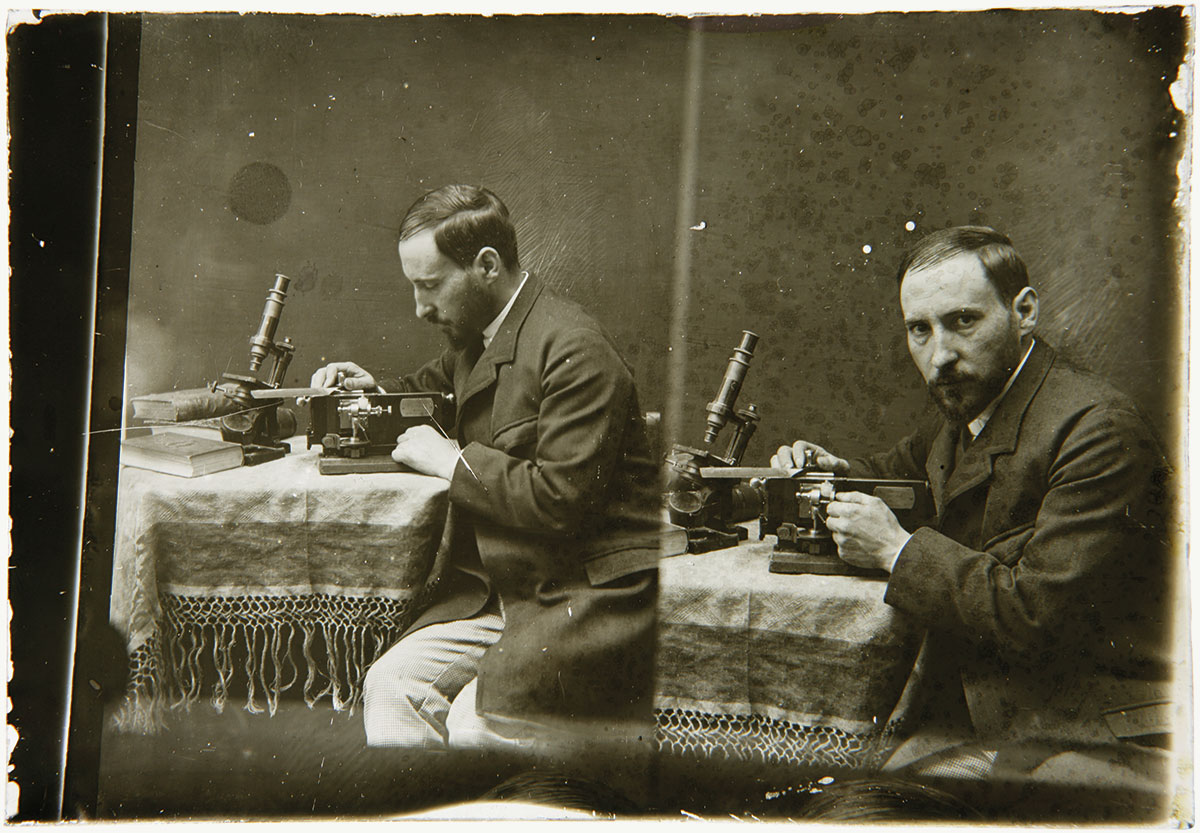
Self-portrait of Santiago Ramón y Cajal with a microtome; his Verick microscope can be seen in the background, c. 1884. Cajal-CSIC Legacy

After being appointed to the chair of Anatomy at the University of Valencia, the family moved to the city in 1884, and Cajal began publishing Manual de histología normal y de técnica micrográfica (Manual of normal histology and micrographic technique) in instalments. The following year, he was commissioned by the Provincial Council of Zaragoza to conduct a study on cholera, which he carried out successfully.

Cajal made significant discoveries in the field of cholera vaccination. Specifically, he used heat-killed bacteria to induce immunity for the first time in history. He did not patent the method, and the invention of the chemical vaccine is nowadays attributed to the Americans Salmon and Smith, who described it a year later.

1888
“A CROWNING YEAR, A YEAR OF FORTUNE”

Building on Golgi’s method, Cajal proposed the theory of the neuron. Cajal described the central nervous system as being composed of individual cells—neurons—that connect with one another but function as independent units, contrary to the accepted belief that it was a continuous network.

My crowning year, a year of good fortune, because during this year, which rises in my memory with the glow of dawn, those eagerly awaited and coveted discoveries finally emerged.

HISTOLOGICAL TECHNIQUE

Histological techniques include processes such as fixation, dehydration, embedding, sectioning, staining and examination of tissues for microscopic analysis. Santiago Ramón y Cajal learnt the Golgi staining method from Luis Simarro. However, it was slow and stained only a few cells. He then improved upon this by adding osmium tetroxide, reducing the procedure time to one week.
The first illustration published by Cajal of a histological specimen (chicken cerebellum) stained using the Golgi method, 1888.