CHAPTER 6

1889

1899

In 1889, he published the book Manual de histología normal y de técnica micrográfica (Manual of normal histology and micrographic techniques). He travelled to Berlin for the meeting of the German Anatomical Society, where he persuaded Rudolph Albert von Kölliker, an internationally renowned figure, to examine his specimens. Captivated by them, Kölliker proclaimed, “I have discovered you, and I wish to share my discovery in Germany”. Cajal then gained international recognition.

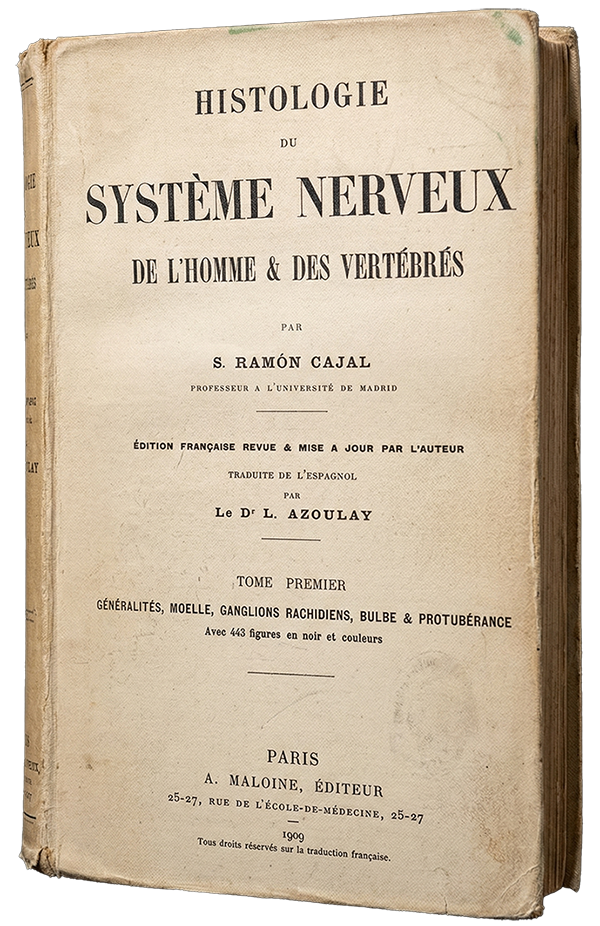
He intensified his research on the embryonic development of the nervous system, and his Manual de anatomía patológica general (Manual of general pathological anatomy) was published. In 1892, he was appointed professor of Normal Histology, Histochemistry and Pathological Anatomy at the Faculty of Medicine of the Central University of Madrid and moved to the capital. Cajal began to gain national recognition, even as his international success spread.

During these years, he continued his intense work, founding the Revista trimestral micrográfica (Quarterly micrographic review) (1896), beginning to publish Textura del sistema nervioso del hombre y los vertebrados (Texture of the nervous system of man and the vertebrates) in instalments (1897–1904) and seeing the publication of Reglas y consejos sobre la investigación biológica (Advice for a young investigator) (1899).

NEURONS

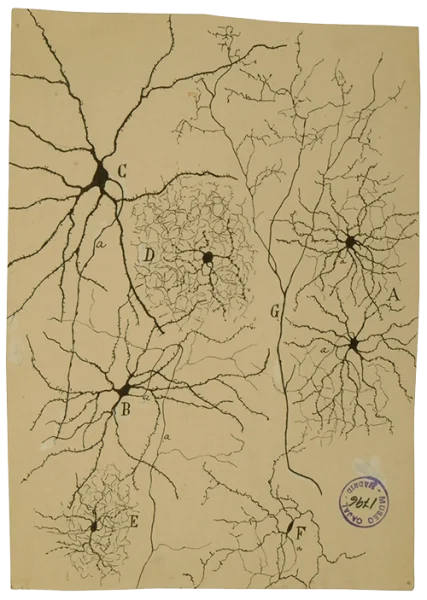
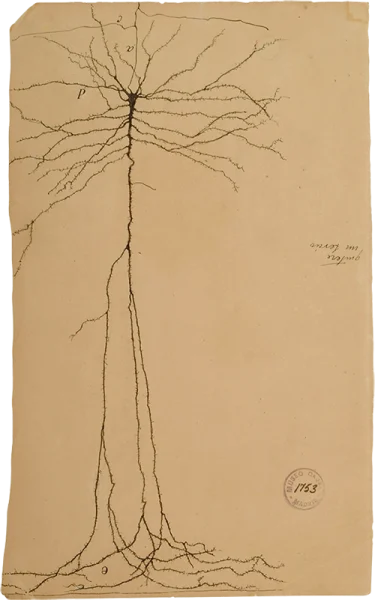
The human brain contains about 86 billion neurons that communicate via electrical impulses and neurotransmitters. Although there are different types, they all share a basic structure: the dendrites receive information, the cell body processes it and the axon transmits it to other cells at high speed.

SYNAPSE

Neurons communicate via electrical impulses that generate an action potential and travel from the cell body to the axon. Since they are not directly connected, the message must cross the synaptic cleft via neurotransmitters, which travel from the sending neuron to the receiving neuron. The synapse was confirmed using an electron microscope in the 20th century.

Self-portrait at the microscope , c. 1910–1912

[…] the garden of neurology offers researchers captivating insights and unparalleled artistic inspiration. There, at last, my aesthetic instincts found complete satisfaction.