CHAPTER 7

1900

1906

ACADEMIC ACHIEVEMENTS

Santiago Ramón y Cajal achieved his first major international academic success in Germany in 1889, when he convinced Kölliker of the validity of his findings. In 1894, the Royal Society of London commissioned him to deliver the opening lecture of the academic year, and the University of Cambridge awarded him an honorary doctorate. It would be the first of many.

Following his recognition abroad, Cajal gained public prominence in Spain. In 1900, he won the Moscow Prize in Paris, and the Biological Research Laboratory—the precursor to the Cajal Institute—was established. In 1905, he received the prestigious Helmholtz Medal in Germany and in 1906, the Nobel Prize in Physiology or Medicine.

ARAGONESE HONOURS

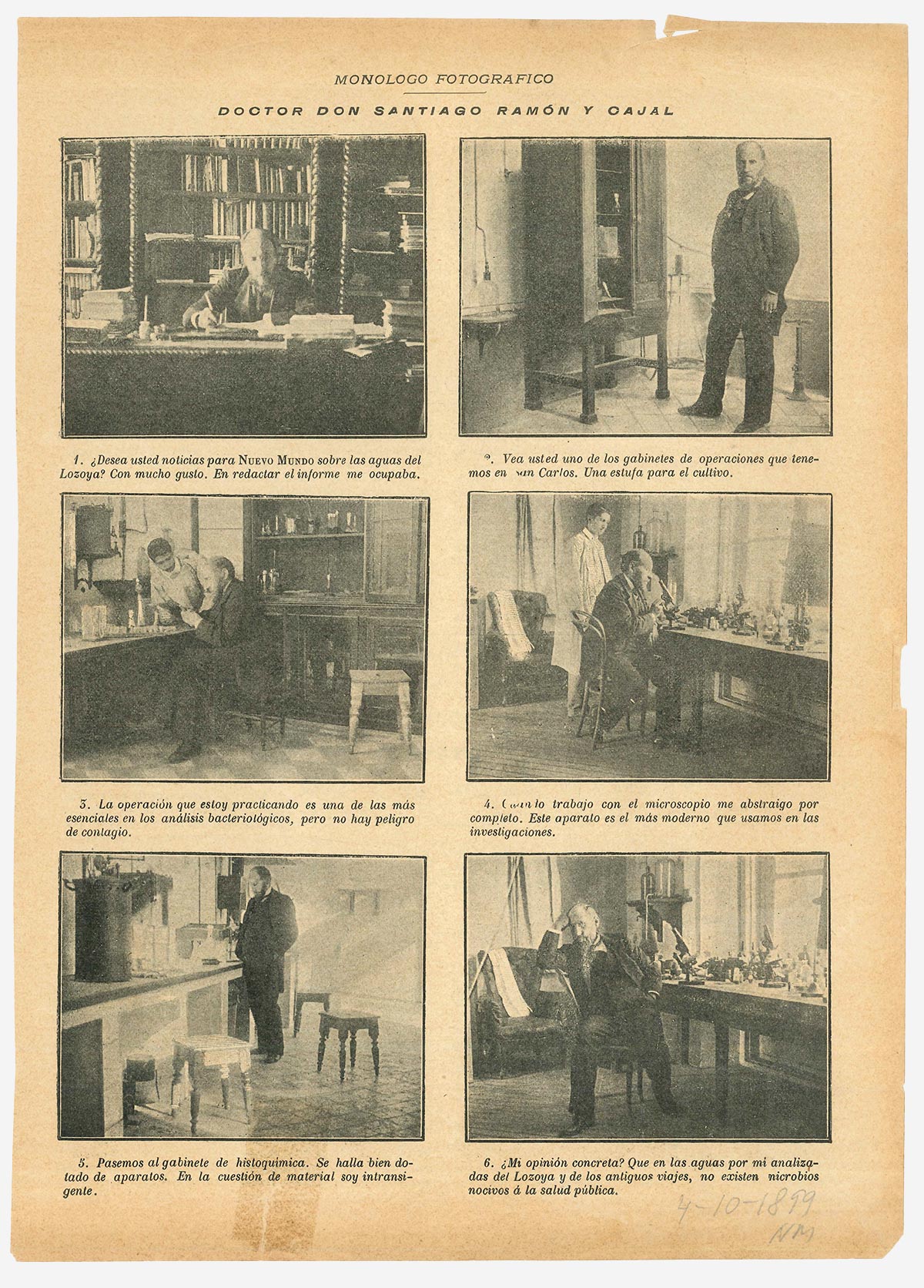
Cajal was recognised by Aragonese institutions very early. The Provincial Council of Zaragoza awarded him the title of “Honorary son of the province” (1900); the City Council of Zaragoza named the first street in the world after him (1901) and also named him an “Adopted son of the city” (1905).

Before boarding the train to receive his Nobel Prize, Santiago Ramón y Cajal was seen off by his students at Madrid’s Estación del Norte. At the time, Cajal’s face was not widely recognised, so to identify him in the photograph, the newspapers marked a white “X” on his coat.

NOBEL PRIZE

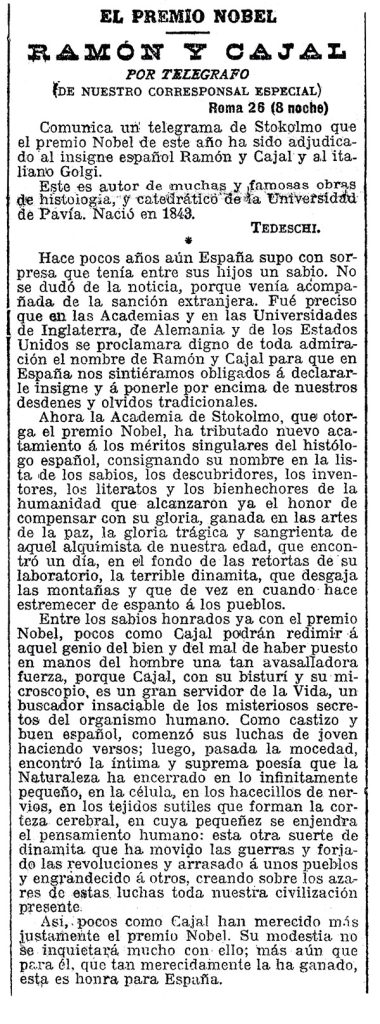
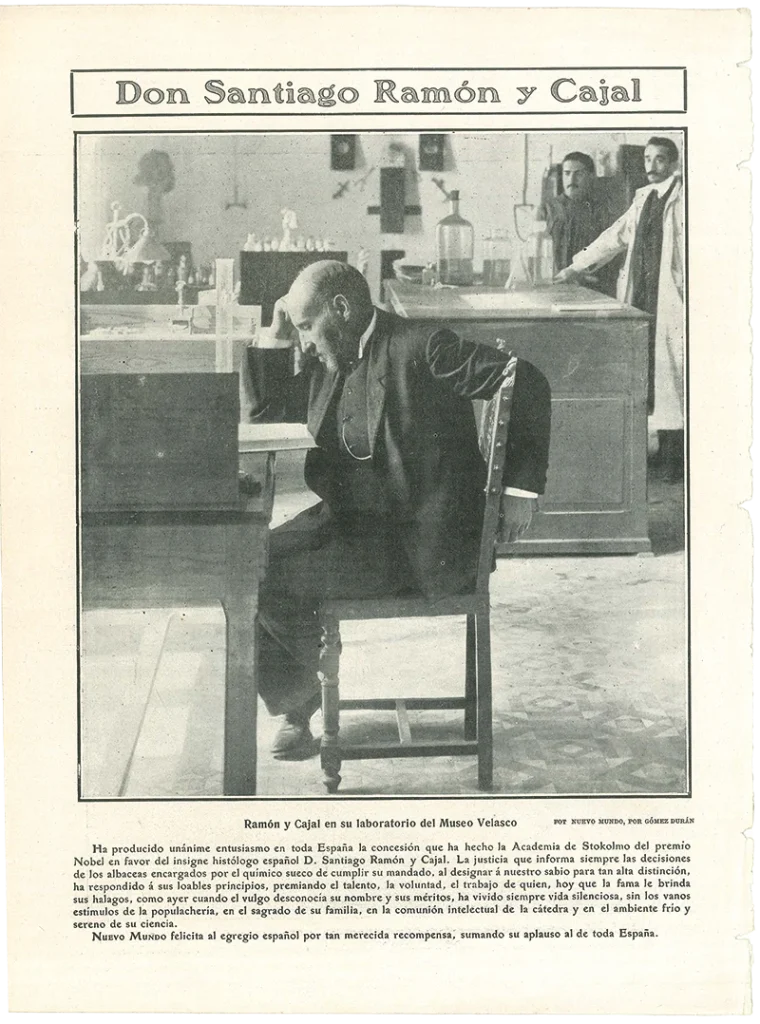
On Saturday, October 27, 1906, the afternoon newspapers reported the arrival of a telegram from Stockholm stating that the Nobel Prize in Physiology or Medicine had been awarded to the Spaniard Santiago Ramón y Cajal and the Italian Camillo Golgi. On December 1, he left for Stockholm, seen off by a crowd of students, and on the 10th he received the award. He stayed in Sweden for a few days, giving lectures and attending official receptions.
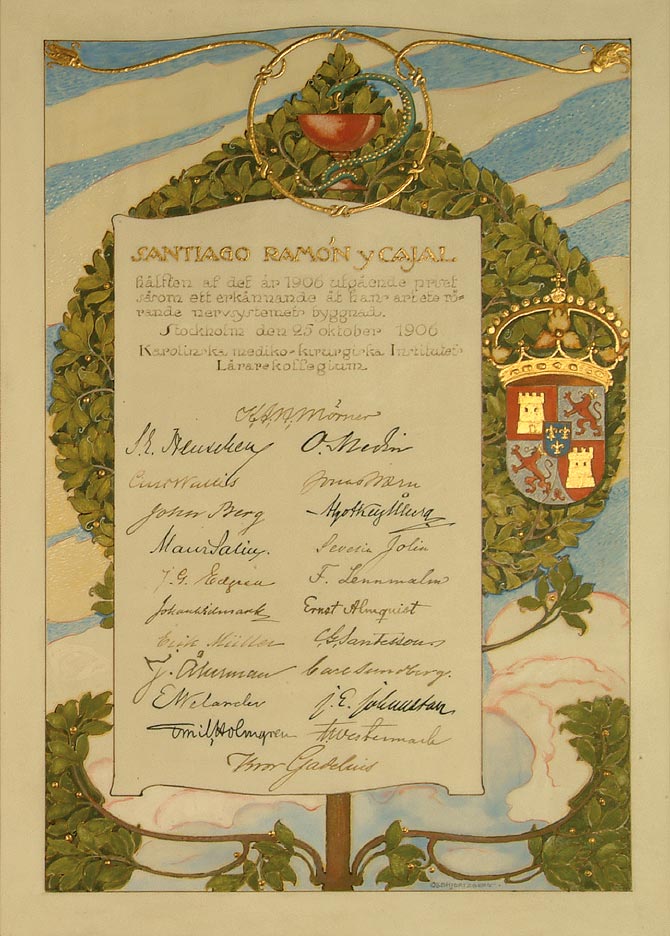
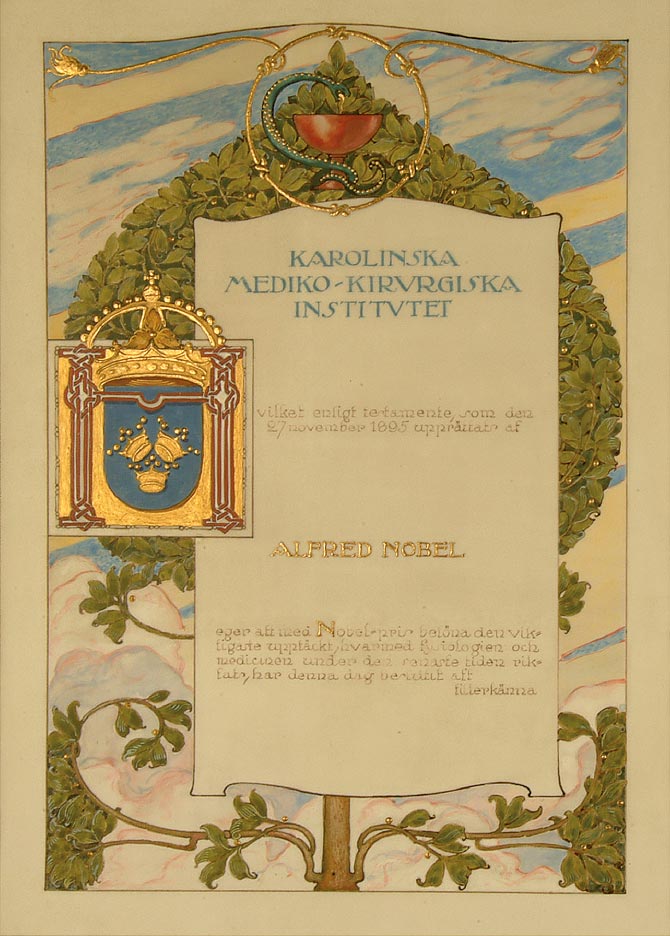
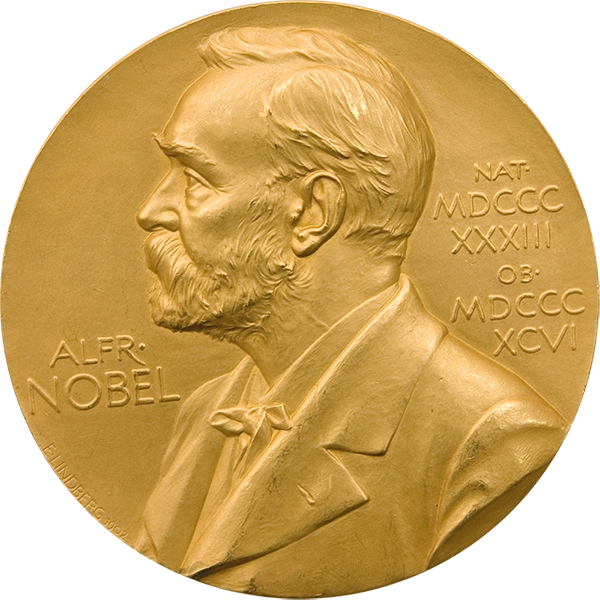
Nobel Prize in Physiology or Medicine diploma and medal awarded by the Royal Carolingian Medical-Surgical University, Stockholm, Sweden, to Santiago Ramón y Cajal, 1906

The committee of dignitaries proposed minting a commemorative medal—funded by public subscription and sculpted by Benlliure—which bore the inscription “To scientific merit for the Nobel Prize… From the Spanish lovers of progress”.

Mariano Benlliure, Commemorative Medal for Scientific Merit from the Nobel Prize, 1907