1922 1934
TOWARDS
THE END
On May 1, 1922, Cajal retired upon turning seventy. On August 23, 1930, his wife Silveria passed away. Cajal still lived with his daughter Fe, who was a widow. Since then, he spent his autumns in Zaragoza, at his brother Pedro’s house on Costa Street, where his sisters looked after him. In 1933, he published his work ¿Neuronismo o reticularismo? Las pruebas objetivas de la unidad anatómica de las células nerviosas (Neuron theory or reticular theory? Objective evidence of the anatomical unity of nerve cells), which is considered his scientific legacy. He died the following year at the age of eighty-two.

¿Neuronismo o reticularismo? Las pruebas objetivas de la unidad anatómica de las células nerviosas (Neuron Theory or Reticular Theory? Objective Evidence of the Anatomical Unity of Nerve Cells), Madrid, Archives of Neurobiology, 1933. A copy inscribed to Francisco Tello by Cajal himself. University of Zaragoza Library
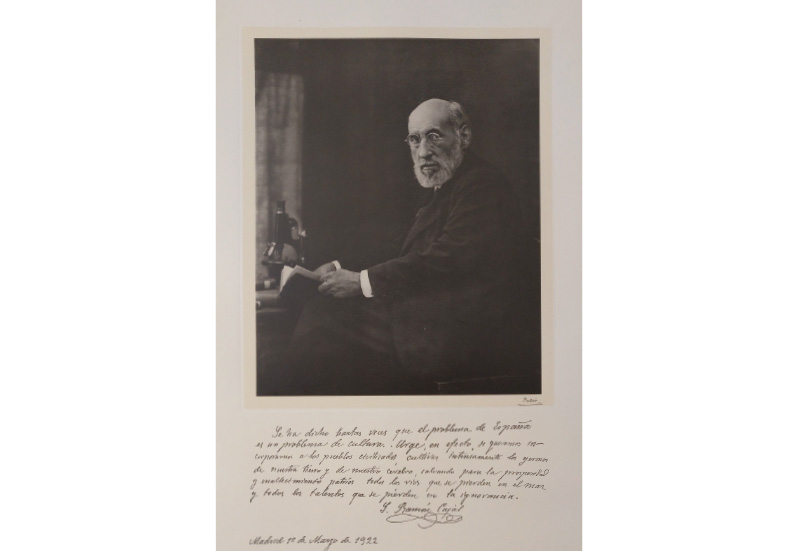
José Padró, Official portrait of Cajal on the day of his retirement. Produced to mark this event on May 1, 1922, in Madrid, 1922. University of Zaragoza Collection
It has been said time and again that Spain’s problem is a cultural one. Indeed, if we wish to join the ranks of civilised nations, we must urgently and vigorously cultivate the barren lands of our country and the barren minds of our people, ensuring that all the rivers that flow into the sea and all the talents lost to ignorance are harnessed for the prosperity and glory of our homeland.
Starting in 1894, Santiago Ramón y Cajal became an increasingly popular figure in Spain. Strangely enough, he was someone who had made a name for himself abroad, which gave him immunity from potential local jealousy. The Moscow Prize and, subsequently, the Nobel Prize amplified and broadened that recognition, which until then had been limited to academic spheres, the press and official circles. But it was upon his retirement in 1922 that, in his own words, “a deluge of honours and tributes” came his way. In his last years, he remained active, although his pace gradually declined. He died on October 17, 1934, at a tragic moment in Spanish history, and his funeral was perhaps the last time that people who would later clash dramatically in the Civil War gathered together around a shared symbol.
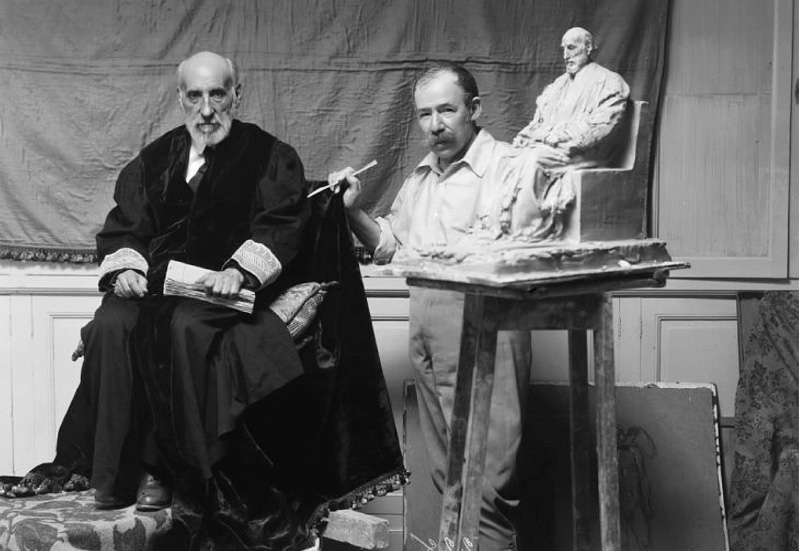
Santiago Ramón y Cajal in Mariano Benlliure’s studio, posing for the model of the statue that will stand at the top of the staircase in the University of Zaragoza’s Paraninfo, 1922
To honour him on the occasion of his retirement, the University of Zaragoza commissioned Mariano Benlliure in early 1922 to create a statue of Ramón y Cajal to be placed at the top of the main staircase of the Paraninfo. It was agreed that the cost would be covered by public subscription. When he had already made progress on his work, Benlliure told Rector Royo Villanova: “In the statue of the great Cajal, I have put my whole artistic soul into creating a work worthy of the great figure it represents,” and he described Cajal as both collaborative and enthusiastic. On October 1, at the start of the academic year, a plaster model was installed at its current location, which was later removed to make way for the final marble sculpture. Cajal was unable to attend the launch event, but he sent two texts to be read aloud. In February 1925, the final statue was unveiled at a ceremony presided over by King Alfonso XIII. The University Archives of Zaragoza hold a large collection of documents and correspondence related to this tribute.